
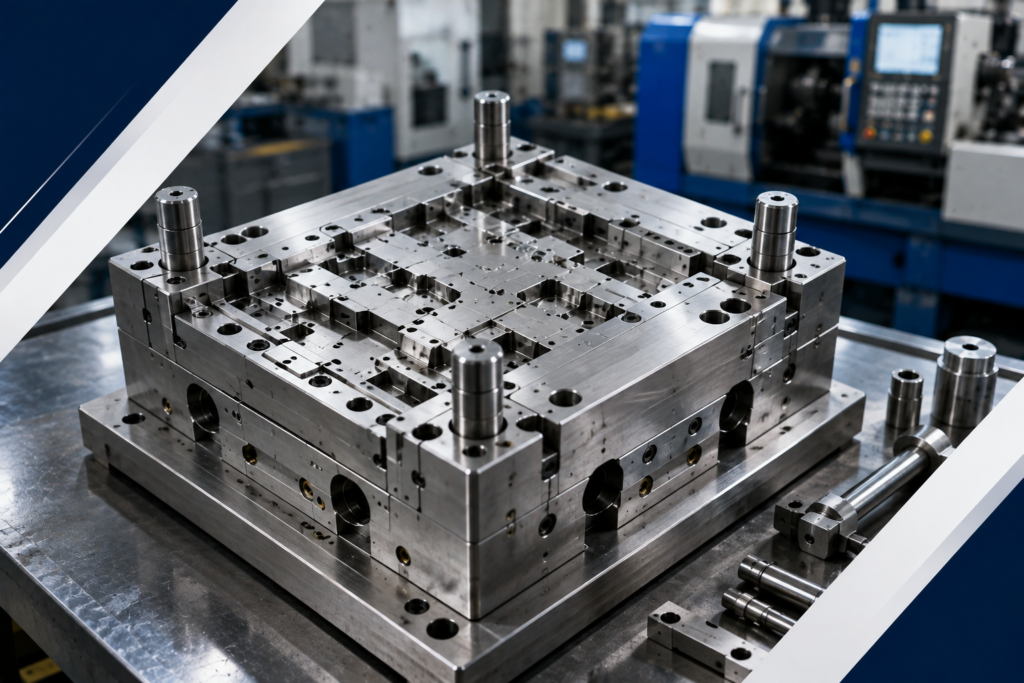
For businesses developing custom plastic products, the mould is one of the most important parts of the manufacturing process. A well-designed mould can support consistent production, efficient cycle times and reliable product quality.
Choosing the right plastic mould manufacturer in Malaysia is therefore an important decision for companies planning a new plastic product or component.
Whether you are producing plumbing hardware, industrial components, consumer products or custom plastic parts, the quality of the mould can have a direct impact on the final product.
What Is a Plastic Mould?
A plastic mould is a specially engineered tool used to shape molten plastic into a specific product or component.
In injection moulding, plastic material is heated and injected into the mould under pressure. The material then cools and solidifies before the finished product is ejected.
The mould determines many aspects of the finished component, including:
- Shape
- Dimensions
- Surface details
- Product geometry
- Parting lines
- Injection points
- Ejection points
For this reason, mould design should be carefully considered before production begins.
Why Is Mould Quality Important?
The mould is used repeatedly during production.
If the mould is poorly designed or manufactured, businesses may experience:
- Dimensional inconsistencies
- Flashing
- Short shots
- Warping
- Surface defects
- Difficult part ejection
- Longer production cycles
- Higher rejection rates
A well-designed mould, on the other hand, can help improve production consistency and reduce unnecessary manufacturing problems.
How Does Plastic Mould Development Work?
Developing a mould normally involves several stages.
1. Product Design Review
The process begins with reviewing the product design.
The manufacturer evaluates whether the proposed product can be efficiently manufactured using injection moulding.
Important factors may include:
- Wall thickness
- Draft angle
- Product geometry
- Material shrinkage
- Parting line
- Gate position
- Ejection system
Early design review can help identify potential problems before the mould is manufactured.
2. Mould Design
Once the product design has been reviewed, the mould design can be developed.
The mould designer needs to determine the appropriate:
- Cavity arrangement
- Core structure
- Runner system
- Gate design
- Cooling channels
- Ejector system
- Parting line
The final design should balance product quality, production efficiency and expected production volume.
3. Tooling and Mould Manufacturing
After the design is approved, the mould can be manufactured.
The manufacturing process requires precision because small dimensional differences can affect the finished plastic component.
Depending on the product, the mould may contain complex cavities, cores, slides or other mechanisms.
4. Mould Testing
Before full production, the mould should be tested.
Initial samples can be inspected to determine whether the product meets the required specifications.
If adjustments are required, modifications can be made to the mould before mass production.
5. Production Approval
Once the sample has been approved, the mould can be used for production.
The production team monitors the injection moulding process to maintain consistent product quality.
What Should You Consider When Choosing a Plastic Mould Manufacturer in Malaysia?
Choosing a mould manufacturer based only on price can create problems later.
Businesses should consider the following factors.
1. Experience With Similar Products
A mould manufacturer with experience in your product category may understand common design and production challenges.
For example, moulds for plumbing components may have different considerations from moulds for electronic housings or industrial components.
2. Engineering and Design Capability
A capable mould manufacturer should be able to evaluate the product design before manufacturing the tool.
This can help identify potential issues with:
- Material flow
- Product thickness
- Shrinkage
- Ejection
- Cooling
- Product deformation
3. In-House Tooling Capability
Having tooling expertise within the manufacturing operation can simplify communication.
Instead of transferring information between several suppliers, businesses can work with one team throughout the design, mould and production stages.
4. Prototype and Sample Support
Testing the mould before mass production is important.
A manufacturer should be able to produce samples and support modifications where required.
This allows customers to verify the product before committing to larger production quantities.
5. Mould Maintenance
Moulds require maintenance, especially when they are used for high-volume production.
Regular inspection and maintenance can help identify wear, damage and other issues before they affect production.
Types of Plastic Products That Require Custom Moulds
Custom moulds can be used for a wide variety of products.
Plumbing Hardware
Plastic taps, valves, connectors and other plumbing components often require moulds designed specifically for their product geometry.
Bathroom Accessories
Custom moulding can be used to produce bathroom accessories with specific shapes, dimensions and finishes.
Industrial Components
Industrial machinery and equipment may require specialised plastic components that are not available as standard products.
Consumer Products
Custom plastic moulding allows businesses to develop products according to their own design and branding requirements.
Mould Design and Material Selection
Material selection should be considered together with mould design.
Different plastics have different characteristics, including:
- Shrinkage
- Flow behaviour
- Melting temperature
- Cooling requirements
- Strength
- Flexibility
For example, a mould designed for one material may require different processing considerations when another material is introduced.
Working with an experienced plastic mould manufacturer can help businesses consider these factors before production.
Why Local Plastic Mould Manufacturing Can Benefit Malaysian Businesses
For companies based in Malaysia, choosing a local plastic mould manufacturer can provide practical advantages.
Easier Communication
Local teams can communicate directly regarding design changes, samples and production requirements.
Faster Sample Review
Businesses can potentially review and approve samples more efficiently without managing long-distance communication and shipping between multiple countries.
Easier Mould Modifications
If a mould requires adjustments, communicating directly with the tooling team can simplify the process.
Better Production Coordination
When mould development and plastic production are handled by closely connected teams, businesses can reduce unnecessary communication gaps.
Sin Yang Plastic’s Tooling and Mould Capabilities
Sin Yang Plastic Enterprise Sdn. Bhd. provides plastic product manufacturing together with tooling and mould development capabilities.
The company states that its in-house tool and design facility supports engineering from design concept through final production. Its experienced toolmakers can assist with prototype development, custom mould construction and mould troubleshooting.
This integrated approach allows businesses to work through different stages of product development with one manufacturing partner.
The company manufactures a range of plastic hardware products, including bib taps, stopcock valves, two-way taps, basin and sink taps and bathroom accessories.
For businesses developing new plastic components, having access to both mould development and plastic production can help streamline the transition from design to mass production.
Questions to Ask a Plastic Mould Manufacturer
Before starting a project, businesses can ask potential manufacturers:
- Can you review my existing product design?
- Can you develop the mould in-house?
- Can you produce prototypes or samples?
- What materials can the mould support?
- What production volume is the mould designed for?
- How will mould maintenance be handled?
- Can you modify the mould if the sample requires changes?
- Can you provide plastic injection moulding after the mould is completed?
These questions can help businesses understand whether the manufacturer can support the entire project rather than only the initial tooling stage.
Final Thoughts
A plastic mould is a long-term manufacturing asset and should be treated as an important part of the product development process.
Choosing the right plastic mould manufacturer in Malaysia can help businesses improve product consistency, reduce production problems and create a smoother path from prototype to mass production.
The most important factors to consider include:
- Engineering capability
- Mould design
- Tooling precision
- Prototype support
- Material knowledge
- Mould maintenance
- Injection moulding capability
- Quality control
For businesses developing custom plastic products, working with a manufacturer that can provide both mould development and plastic production can make the entire process more efficient.
If you have a plastic product concept, drawing or existing sample, contact Sin Yang Plastic to discuss your tooling and manufacturing requirements.
Frequently Asked Questions
Common questions about plastic mould manufacturing