
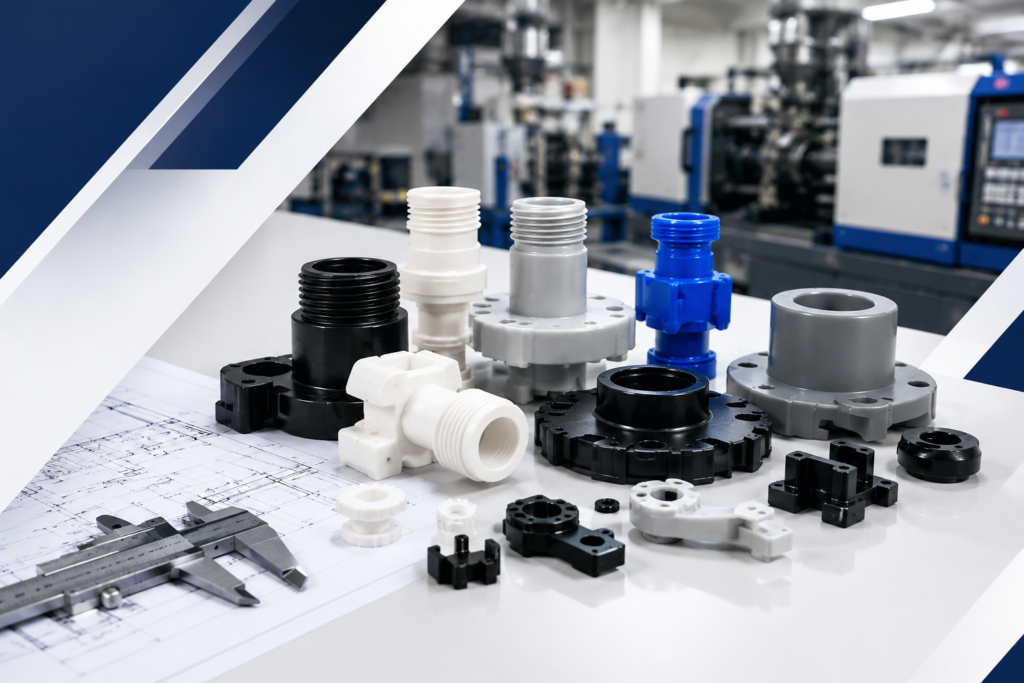
Businesses across Malaysia increasingly rely on custom plastic components for products, machinery, plumbing systems, hardware and industrial applications. Unlike standard off-the-shelf components, custom plastic parts are designed and manufactured according to specific dimensions, performance requirements and application needs.
For companies looking for custom plastic parts in Malaysia, choosing the right manufacturing partner is important. A capable manufacturer can support the entire process, from product concept and prototype development to mould production, injection moulding and final quality inspection.
What Are Custom Plastic Parts?
Custom plastic parts are components manufactured according to a customer’s specific design or technical requirements.
Depending on the application, a custom plastic component may require specific:
- Dimensions
- Shapes
- Materials
- Colours
- Surface finishes
- Mechanical properties
- Thread specifications
- Connection points
- Tolerances
Custom plastic parts are commonly used in plumbing, construction, industrial equipment, automotive applications, electronics, consumer products and other manufacturing sectors.
Instead of adapting an existing product to fit a particular application, businesses can work with a manufacturer to develop a component specifically for their requirements.
Why Businesses Choose Custom Plastic Parts
There are several reasons why businesses may choose custom plastic components instead of standard products.
1. Better Product Fit
A custom component can be designed to match the exact dimensions of an existing product or assembly.
This is particularly useful when standard components do not provide the required:
- Size
- Shape
- Connection
- Thread
- Clearance
- Functional performance
A properly designed custom part can improve the overall fit and functionality of the finished product.
2. Greater Design Flexibility
Plastic manufacturing allows businesses to create components with different shapes and geometries.
Depending on the product requirements, manufacturers can develop components featuring:
- Curved surfaces
- Internal channels
- Threads
- Clips
- Ribs
- Mounting points
- Complex external shapes
This flexibility makes custom plastic parts suitable for many different industries.
3. Material Selection
Different plastic materials offer different performance characteristics.
Common materials used for custom plastic components include:
- ABS
- PP
- PE
- PVC
- Nylon (PA)
- POM
The most suitable material depends on the application.
For example, a product exposed to chemicals may require a different material from a component designed primarily for impact resistance or flexibility.
Material selection should therefore be considered during the early design stage.
The Custom Plastic Parts Manufacturing Process
Developing a custom plastic component involves several stages.
Step 1: Product Concept
The process normally begins with a product concept.
Customers may provide:
- Technical drawings
- CAD files
- Existing samples
- Product photographs
- Measurements
- Functional requirements
If a complete design is not available, an experienced manufacturer may be able to assist with product development and engineering considerations.
Step 2: Design Review
Before manufacturing begins, the design should be reviewed to determine whether it is suitable for plastic production.
Important considerations include:
- Wall thickness
- Product dimensions
- Draft angles
- Material selection
- Shrinkage
- Parting lines
- Injection points
- Ejection requirements
Designing a component specifically for injection moulding can help reduce production problems later.
Step 3: Prototype Development
A prototype or sample can be produced before committing to full-scale production.
Prototype evaluation allows businesses to check:
- Product dimensions
- Fit
- Appearance
- Function
- Assembly
- Material performance
Any necessary modifications can then be made before the production mould is finalised.
Step 4: Custom Mould Development
Once the product design has been approved, a custom mould can be developed.
The mould is one of the most important investments in an injection moulding project because it directly affects product consistency, cycle time and production quality.
A well-designed mould should consider:
- Cavity layout
- Cooling system
- Injection gate
- Ejection system
- Parting line
- Material flow
- Expected production volume
Step 5: Injection Moulding Production
After the mould has been completed and approved, production can begin.
Plastic material is heated and injected into the mould under controlled conditions. After cooling, the finished component is ejected from the mould.
The process can then be repeated to produce consistent parts at scale.
Step 6: Quality Inspection
Quality control is essential for custom plastic components.
Depending on the application, inspections may include:
- Dimensional checks
- Visual inspection
- Functional testing
- Material verification
- Surface inspection
- Assembly testing
Consistent inspection helps ensure that production parts meet the agreed specifications.
What Industries Use Custom Plastic Parts in Malaysia?
Custom plastic components are used across many industries.
Plumbing and Water Hardware
Plastic components can be designed for taps, connectors, valves, fittings and other plumbing-related applications.
Industrial Manufacturing
Industrial equipment often requires specialised plastic components that are not available as standard products.
Custom moulded parts can be designed to fit specific machinery or assemblies.
Automotive
Plastic components can help manufacturers reduce weight while providing the required strength, durability and design flexibility.
Electronics
Plastic housings, covers, clips, brackets and other components can be customised according to the dimensions of electronic products.
Consumer Products
Many consumer products require custom plastic components to achieve a particular appearance, function or assembly method.
What Should You Consider When Ordering Custom Plastic Parts?
Before selecting a manufacturer, businesses should consider several factors.
Manufacturing Experience
Look for a manufacturer with experience producing plastic components similar to your application.
Mould Development Capability
A manufacturer with tooling and mould development capabilities can simplify the transition from product design to production.
Material Knowledge
The manufacturer should be able to advise on material selection based on the product’s intended environment and performance requirements.
Production Capacity
Consider both your current order volume and future requirements.
A suitable supplier should be capable of supporting production as your business grows.
Quality Control
Ask about the manufacturer’s inspection and quality assurance procedures.
Consistent quality is particularly important for components that will be incorporated into other products.
Custom Plastic Parts in Malaysia: Why Local Manufacturing Can Help
For Malaysian businesses, working with a local manufacturer can simplify communication, sample approval, product development and production coordination.
It can also make it easier to:
- Discuss design changes
- Inspect samples
- Coordinate mould modifications
- Resolve production issues
- Arrange repeat orders
- Scale production
For businesses developing new products, close communication with the manufacturing team can make the development process more efficient.
Custom Plastic Manufacturing at Sin Yang Plastic
Sin Yang Plastic Enterprise Sdn. Bhd. specialises in plastic hardware manufacturing and custom plastic products.
The company supports customers through different stages of product development, including prototype development, custom mould construction, injection moulding, finishing and quality control.
Its in-house tool and design facility provides engineering support from the initial design concept through to final production.
Sin Yang Plastic also manufactures a range of plastic hardware products, including bib taps, stopcock valves, two-way taps, basin and sink taps and bathroom accessories.
For businesses requiring custom plastic parts in Malaysia, working with a manufacturer that can support both mould development and production can help simplify the entire manufacturing process.
Final Thoughts
Custom plastic parts can provide businesses with greater flexibility, better product fit and more control over their final product.
However, successful custom plastic manufacturing requires more than simply producing a mould.
The process should consider:
- Product design
- Material selection
- Prototype development
- Mould engineering
- Injection moulding
- Quality control
- Production capacity
Choosing an experienced custom plastic manufacturer in Malaysia can help businesses move from an initial concept to a reliable production-ready component.
If you have a drawing, sample or product concept that requires custom plastic manufacturing, contact Sin Yang Plastic to discuss your requirements.
Frequently Asked Questions
Common questions about custom plastic parts manufacturing